How does ensemble stacking work?
MLJAR AutoML combines predictions from multiple models using ensemble selection and stacking. Ensemble selection assigns weights to existing model predictions; stacking trains additional models using predictions as inputs. Compare the resulting models in the AutoML leaderboard and reports.
1. Ensemble
After all Level-0 models are trained step by step (like simple_algorithms, default_algorithms, not_so_random, golden_features, insert_random_feature, feature_selection, etc.), it will start to process the Ensemble step.
In this process, the weight values according to the all Level-0 model will be calculated and become Ensemble model. The final selected Level-0 model and their weight values will list in the ensemble.json under ensemble folder (example file showed as following , The “repeat” here means the weight value of each selected model)
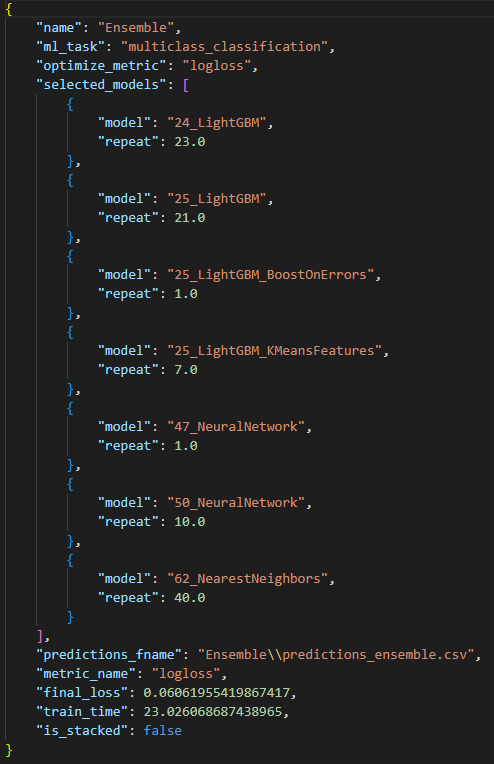
Ensemble selection runs for up to 30 rounds, using saved validation or out-of-fold predictions. Each round can select any eligible candidate, including a previously selected model. Repeated selections increase that model's weight; they do not add prediction work. The best validation combination is retained, so the final ensemble can use fewer than 30 distinct members. This fixed internal limit applies to both ordinary and stacked ensembles and has no public setting. It does not cap the upstream models required by stacked members.
2. Stack
The Stack process flow showed as below:
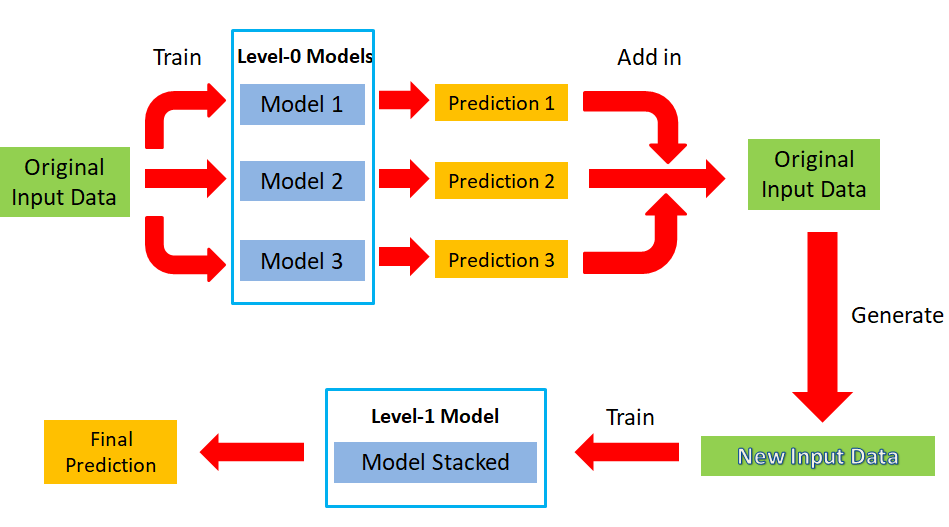
The original input data is used to train several models of Level-0, and the prediction results of the models are added to the original data then generate new input data, which will be used to train the Stacked Model of Level-1 and obtain the final prediction result.
3. Ensemble stacking
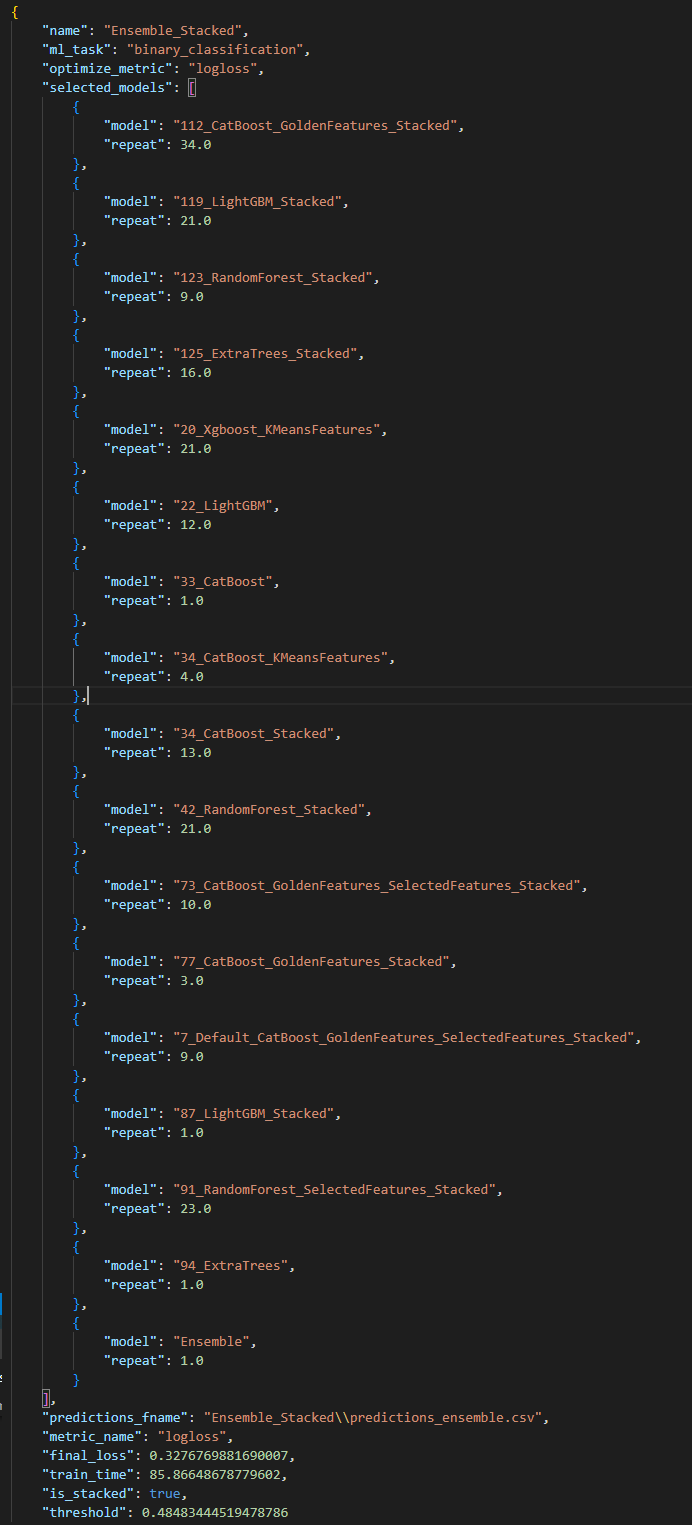
Ensemble stacking means to ensemble the above-mentioned Level-0 and Level-1 models with different weight values and predict final results. The final selected Level-0 and Level-1 models and their weight values will list in the ensemble.json file which under the ensemble_stacked folder. (as shown in the figure below, repeat here means the weight value)
Selecting stacking inputs
New stacks use at most five models per algorithm, ranked by internal validation loss. This is a fixed internal limit with no public setting; it is not a total limit across algorithms. Baseline, random-feature probes, existing stacked models and ensembles are excluded from these inputs. Excluding ensemble inputs prevents their full member lists from adding hidden prediction dependencies. Fairness constraints still apply when enabled. All trained models remain in the leaderboard; the final ensemble can still select ordinary and stacked models.
For new classification training, stacking is disabled if any observed class has
less than 15% of the training rows, even with stack_models=True. Exactly 15%
is eligible if the other constraints allow stacking. Counts exclude missing
targets and ignore sample weights. Regression and ordinary ensembles are
unchanged. This heuristic does not guarantee that a model will avoid overfitting.
The selected input names and order are saved with the run. Loading an older run preserves its original stack, even if it contains more inputs. Reducing an existing stack requires training new stacked models.
Starting in 1.4.0b4, Kumo and TabICLv2 predictions remain eligible inputs for other stacked learners, and their ordinary models can enter ensembles. AutoML does not train new Kumo or TabICLv2 models on stacked data. RealMLP and TabM remain eligible stacked learners. Saved older TFM stacks can still be loaded for prediction.
For new Kumo and TabICLv2 cross-validation runs, validation and ensemble selection
still use fold-based OOF predictions. Inference uses one saved context containing
all training rows, with separately fitted full-data preprocessing. This also
supplies TFM prediction columns to stacked models on new inputs. Full-data
resource admission and preparation run within the training budget; oversized
contexts are skipped, never truncated. framework.json retains the CV learners
under validation_models and records tfm_full_context, while its ordinary
learners and saved fields describe the single inference learner. Holdout runs
and previously saved models retain their original prediction behavior.
With validation_strategy="auto", cross-validation is capped at five folds
when the training data has fewer than 5,000 rows, or classification has fewer
than 250 samples in its smallest observed class. Otherwise Compete and Optuna
can use ten folds. Perform retains its five-fold default; Explain retains its
holdout default. Existing time-budget constraints can still reduce validation.
Counts exclude missing targets, ignore sample weights and are taken before
oversampling. Explicit validation strategies are preserved. The chosen strategy
and auto_cv_policy are saved in params.json.
These are fixed heuristics. Five-fold CV enlarges each validation fold but trains each learner on 80% rather than 90% of the data; better test performance is not guaranteed. Pooled OOF model selection and the existing stacking constraints remain unchanged.
When max_single_prediction_time is set, ensemble construction counts shared
prediction dependencies once, including the inputs needed by stacked models.
Repeated selection of a member changes its weight without adding another
prediction cost. Timings are measurements on the training machine, not a
hardware-independent latency guarantee.
Stacked models in performance plots
The leaderboard includes an is_stacked boolean alongside model_type.
Performance plots, performance boxplots, and fairness plots show ordinary and
stacked variants as separate groups, for example CatBoost and
CatBoost (stacked). This applies to every algorithm and to ensembles, where
Ensemble (stacked) can combine ordinary and stacked models.
Stacked variants keep their algorithm color and use a different marker in
scatter plots. Boxplots summarize each group separately. Scores, model selection,
and the underlying model_type are unchanged. Older leaderboard tables without
is_stacked retain their original grouping.