Find an example for your data
Start with a question similar to yours. Each beginner tutorial includes the data source, a standalone Python script, a notebook, measured results, and real reports. Both use standard CPU models and a 120-second training budget. Total runtime varies; each tutorial records its measured time and hardware.
Start here
Engineering · Regression
Predict a number from a CSV
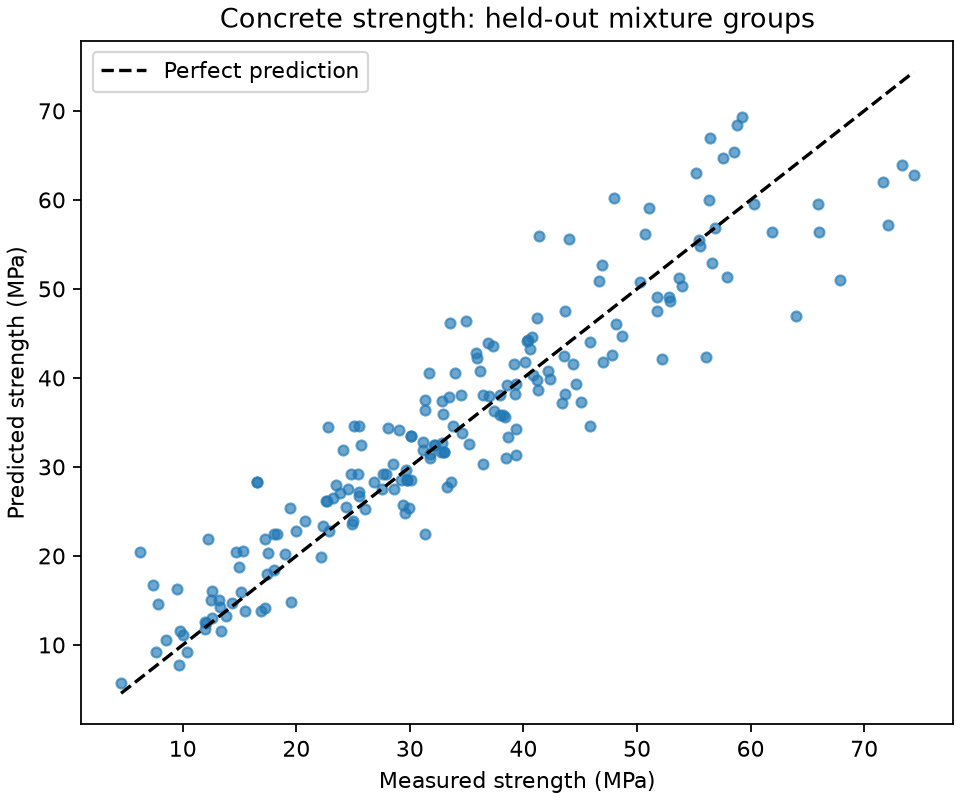
Question: can ingredients and specimen age predict concrete strength?
Learn to choose a target, keep related measurements together, compare errors with a baseline, and reuse a saved model. Data: 1,030 measurements, eight inputs.
Business · Classification
Predict which customers may leave
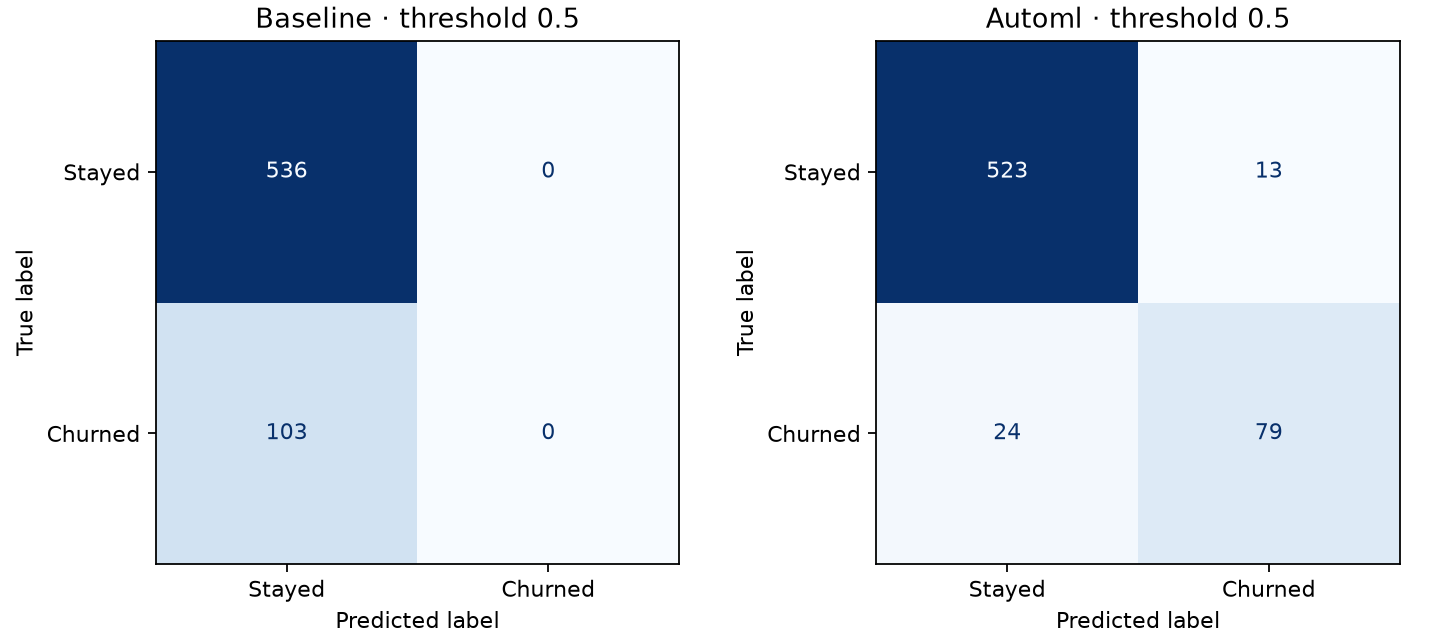
Question: can past service usage help identify customers likely to churn?
Learn probabilities, class imbalance, missed churn, and false alarms. Keep repeated profiles together and verify saved-model predictions. Data: 3,150 rows, ten selected inputs.
These workflows passed script and notebook execution on Python 3.11 and 3.12 with published MLJAR AutoML 1.4.0b1. Their pages link to dataset attribution, recorded versions, resource measurements, and reload checks. Studio walkthroughs, laptop/8 GB measurements, and unassisted beginner reviews remain open.
Choose by learning goal
| I want to… | Start with |
|---|---|
| Predict a number, such as a measurement | Concrete strength |
| Predict a category and understand probabilities | Customer churn |
| Understand the leaderboard and individual reports | Read the reports |
| Make predictions after closing Python | Predict another CSV and reload |
| Use a conversational notebook | MLJAR Studio and a beginner notebook above |
Advanced guides
Once you have a first model, change one part of the workflow at a time. These links include existing reference guides and tutorials; they are not all newly validated 1.4.0b1 example packages. Check each page's dependencies and provenance.
| Task | Guide | What to check |
|---|---|---|
| Define your own evaluation metric | Custom metrics | Optimization direction and the form of the predictions |
| Supply your own validation splits | Custom validation | Tested grouped and time-ordered scripts; separate final test data, gaps, and fold-trained models |
| Generate additional features | Golden features and feature discovery | Validation compatibility, compute cost, and measured benefit |
| Understand model explanations | Explainability | Which explanations are available for your algorithm and explanation level |
| Read reports in Python or an LLM workflow | Reports and structured output | Validation versus test scores and available model details |
| Measure fairness and evaluate mitigation | Binary classification, multiclass, regression | Relevant groups and metrics; performance trade-offs |
| Share single-row and batch predictions | Prediction apps | Runtime dependencies, selected-model artifacts, and local execution versus publishing |
| Try neural tabular models | RealMLP and TabM | Optional backend installation and resource requirements |
| Try tabular foundation models | Kumo and TabICLv2 | Compatible hardware, first-use model downloads, and saved artifacts |
| Choose a search strategy | AutoML modes and training stages | Budget, validation, and the work each mode performs |
More existing examples
These entry points remain available while the collection is reviewed and refreshed. Their historical results should not be read as new beta measurements.
- Classify Titanic passengers.
- Train with IP addresses.
- Classify synthetic data for a focused API example.
- Share a classification model as an app.
- Share a regression model as an app.
Need a setting rather than a tutorial? Open the API reference or installation guide.